

An Alternative Flood Myth
Maybe just a little bit closer

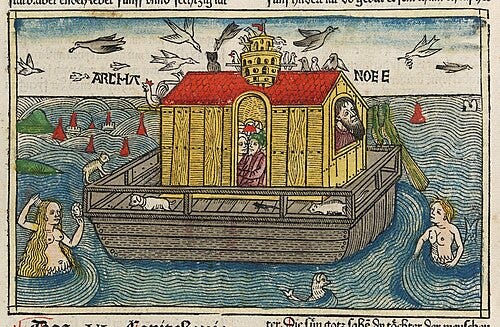
Near Eastern flood myths
Ancient mythologies around the world describe an immense flood. In many cases there is an element of theodicy: the flood erases a failed iteration of evil humanity, making room for a new population of people who could try to be better.
In the Epic of Gilgamesh, the gods are irritated by the noise of the large human population. Utnapishtim is warned by Ea of a coming flood, builds a large vessel and survives, together with a large group (his family and craftsmen).
In Genesis in the Bible, God is angry at the evil of human society. Noah is warned by God of the coming flood, builds a large vessel and survives together with his family.
In Ovid’s Metamorphoses, referencing earlier myths, Zeus (a reflex of the ancient name Dyewus, meaning light, sky or perhaps God) is disgusted by the impiety of society. Deucalion and Pyrrha survive in a box and repopulate the world.
Other flood myths from around the world
The ideas of judgment, a warning of a coming deluge and preservation of a select few pop up again and again.
There are many examples, but in this group the mechanisms vary, depending on different cosmologies.
There is Manu and the fish in the Shatapatha Brahmana. The Quiché Maya myth in the Popol Vuh describes a flood that wipes out a flawed earlier wooden iteration of humanity. Gun-Yu in China and Bergelmir in Norse mythology offer additional myths, always with a judgment, a warned survivor, a preserved remnant and the repopulation of the world.
It is noticeable that the Near Eastern and Mediterranean examples have more features in common, and these myths have been preserved in areas within striking distance of the Black Sea.
Key features of flood myths:
- Divine judgment based on evil behaviour
- Someone was warned
- Some people survived
- Boats
- A story about repopulation
Real floods
As global sea levels rose after the last glacial maximum, floods have occurred in several places that were capable of drowning human populations living on a shrinking island that was too far from the nearest mainland coast. The most obvious example of this in the Northern Hemisphere is Doggerland.
The Black Sea is a large body of water that was cut off from the world’s oceans and had a much lower level at the Last Glacial Maximum. That much is uncontroversial.
On at least two occasions, a communication has been established between the Black Sea Lake and either the Caspian Sea (around 14000 years ago) or the Mediterranean (around 8500 years ago).
Ryan & Pitman (1998 and 2003) postulated that this flood could have been catastrophic, leading to the Black Sea Deluge Hypothesis. This was very controversial, and a very long series of publications since 1998 have sought to either support or disprove their underlying idea that a) the Black Sea was around 100m lower when the Bosphorus channel opened and b) the flow of water occurred quickly. I am not a geologist, but from my study of this the jury is still out. There are wave-cut terraces that seem to have been drowned suddenly, and large boulders near Istanbul appear to have been rolled away, but very clever people who understand carbon dating and seashells think the flood was slow. I decided the uncertainty was permission enough.
The mythology of In the Day of the Flood
[Spoiler alert]
To write the first book in the Four Lights series I decided to imagine a society that might have existed 8500 years ago along the much wider Black Sea coastal strip. For this I needed several things:
- a language. I am a polyglot translator so could not resist this challenge: the language Méri was reverse-engineered from Proto-Indo-European words and structures to form a simple agglutinative ancestor language
- a cosmology. This was drawn from the Proto-Indo-European mythology of dyewus (the sky father) and dheghom (the earth mother), the names slightly adapted.
- unacceptable human behaviour. It occurred to me (and I then verified) that human sacrifice and population-control child exposure were optional during this period; they existed in some areas, but not in others. The story of Abraham and Isaac in Genesis may be a reflex of this unresolved question.
- a god to cause the flood and a proposed mechanism. The sky (dyewus, rewritten for 8500 years ago as Déya), is the obvious candidate. The sky is above people and whatever they do is done under the sky: it is therefore conceived as a witness. It is thus an obvious locus for moral accountability.
- a cosmological mechanism. What would a god witnessing human cruelty do? Weeping seems an obvious reaction. The influx of salty water from the Mediterranean into the Black Sea, killing all the fish, could plausibly be interpreted as the tears of the sky.
- a person who received a warning. Here there were many options, but Neolithic people were not unaware of simple concepts like the downhill flow of water. Anyone witnessing the Bosphorus breach and the increasing flow of salty water into their freshwater lake could easily have extrapolated from this that bad things were likely to happen down on the freshwater shore. The societies of the time were not necessarily patriarchal; there are even signs that women may have had a higher status in some areas. Thus my Utnapishtim becomes a young woman (although I gave her two young men for company).
- a saved population. This is where the archaeological record gets interesting. Populations around 8500 BC (Çatalhöyük, other similar settlements in Thrace) were relatively advanced in the preceding centuries. Around this time, relatively sophisticated farming societies pop up not adjacent to the former Black Sea shore, but some distance inland. The obvious inference: the fertile land near the coast was crowded. Refugees had to travel further inland, bearing tales of their drowned lands. All this is material ripe for fictional retelling.
- boats. A huge vessel on the scale of Gilgamesh or the Bible was not feasible 8500 years ago, but there were boats aplenty. Although this was a time before both the wheel and metallurgy, boats could easily be made by bundling and tying reeds together, and there are representations of boats in cave paintings. These were probably used for coastal travel, binding together the Black Sea littoral before the flood into a semi-cohesive trading zone. We know for certain that they traded in obsidian and amber, creating further material for the author’s fertile imagination.
[Spoiler alert ends]
Summary
Thus In the Day of the Flood eventually became an attempt to recreate events that could at least possibly, if not plausibly, have happened. I wanted to create lives and situations that could have existed in that context, and tell the very first iteration of exaggerated tales that could possibly have given rise to some of the myths that have survived all the way into our time.
In doing so, I wanted to sow plausible seeds for the broad outline of the consistent legends that came into being in the Near East: evil behaviour, an aggrieved celestial witness, a warned group, widespread flooding and destruction, and a saved remnant.
Find out more about The Four Lights series:

Start reading In the Day of the Flood:

I want to own In the Day of the Flood:
Amazon.co.uk (free download soon, or £11.99 for paperback)
Amazon.com (free download soon or $15.99 for paperback)
BookFunnel (free download now)
Apple, Nook, Kobo and all the others (free download now)
(Cover image from Wikipedia - A woodcut of Noah's Ark from Anton Koberger's German Bible)
.
Sped through the spoiler alert because I'm not finished yet, but this is part fo what attracted me to your book in the first place - the ancient flood mythology (and reality). It's fascinated me for years and tugs on Atlantis-vibe threads too!!